Posts
Updates from the group — also posted on our LinkedIn page.
2026 (5)
-
 EDGE GroupProgramme and registration ↗
Hello X-HEEPers! 💃 We are happy to invite you to a new edition of the X-AGORA, the X-HEEP eXchange space, taking place alongside HEEP-UP on November 12–13, 2026, in Madrid, Spain!
📈 Since its first commit, the X-HEEP Platform has grown into an international open-source hardware project, bringing together researchers and developers from academia and industry. Now supported by a consortium between EPFL, Universidad Politécnica de Madrid, and Politecnico di Torino, X-HEEP continues to grow through the contributions of its community.
November 12, 09:00–18:00 | HEEP-UP (how to go from an idea to a full RISC-V SoC) A day for newcomers who want to learn about X-HEEP and its ecosystem, and for those trying to KEEP-UP with the latest improvements on the platform: introductory talks and hands-on tutorials. Registration is required for the hands-on sessions, and places are limited!
November 13, 09:00–12:00 | 5th X-AGORA (the X-HEEP eXchange space) Our traditional community gathering, where everyone working with X-HEEP is invited to share projects, experiences, and latest developments. One slide, up to two minutes, any topic related to X-HEEP! The session concludes with presentations of the latest X-HEEP-based chip tape-outs (CHEEPs).
Want to present? Add your slide to the shared presentation by November 12, respecting the provided template: one slide per topic or project, two minutes at most.
🗓️ When: November 12–13, 2026 📍 Where: ETS de Ingenieros Industriales, Universidad Politécnica de Madrid, Spain 💻 Online participation: https://lnkd.in/dvy5ya2d
Everyone is welcome, and there is no need to register for the talks. Forward this invitation to colleagues and students who might be interested!
David Atienza, David Mallasén Quintana, Michele Caon, Jose Miranda, Daniel Vázquez, Andrés Otero, Luigi Giuffrida, Alessandra Dolmeta
-
EDGE GroupRead the paper ↗
PolHEEPo is now published! 📄 “PolHEEPo: A 65 nm 6mm² RISC-V SoC Filling the Gap Between Cloud and Edge Computing” (L. Giuffrida et al.) has appeared in IEEE Transactions on Circuits and Systems II: Express Briefs.
The paper describes the RISC-V SoC integrating accelerators for artificial intelligence and post-quantum cryptography that we’ve been reporting on since fabrication and testing.
Read the paper 👇
-
EDGE GroupRead on #PoliFlash ↗
It’s called Polheepo — flexible, customizable, and built for businesses: the new chip developed by DET, Politecnico di Torino, as part of the Fondazione SERICS project harnesses the potential of the open RISC-V architecture to adapt to specific production needs, overcoming the limits of traditional devices, which are often closed and hard to modify.
🤖 Currently in the testing phase, Polheepo integrates accelerators for artificial intelligence and post-quantum cryptography, making it suitable for edge, embedded, and low-power applications across multiple sectors. After the initial baseline tests, experiments are now underway on engineered boards, with possible applications in the biomedical and agricultural fields.
Read more on #PoliFlash 👇
-
EDGE Group
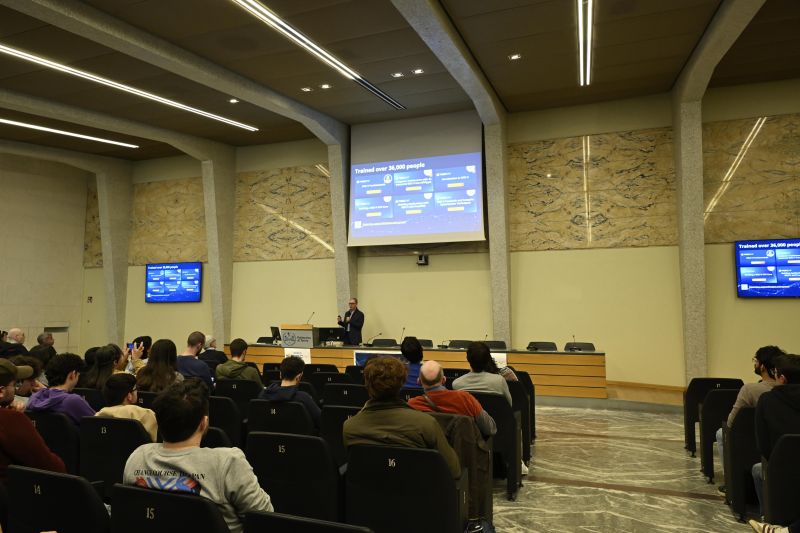
The World RISC-V Days Turin 2026 talks are finally live on our YouTube channel! 🎥
#RISCVEverywhere
World RISC-V Days Turin was organized by Alessandra Dolmeta and Luigi Giuffrida — the recordings include Luigi’s own presentation, so don’t miss it.
Check them out 👇
Watch on YouTube ↗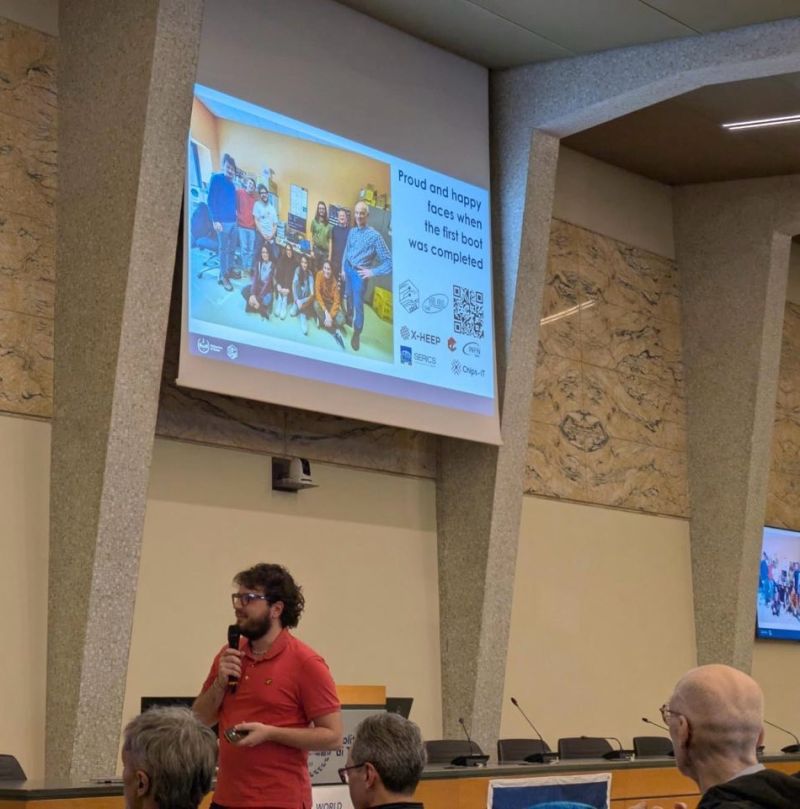
-
EDGE GroupRead the SERICS article ↗
Prof. Maurizio Martina, professor of electronics at Politecnico di Torino, reports to SIE — the Italian Electronics Society — that, thanks to the PNRR SERICS project and with the technical support of Fondazione Chips-IT, a chip in TSMC 65 nm technology has been sent to fabrication.
The chip, named Polheepo, is based on a RISC-V processor together with several accelerators for artificial intelligence and post-quantum cryptography.
To learn more, we’re sharing the article published by Fondazione SERICS 👇